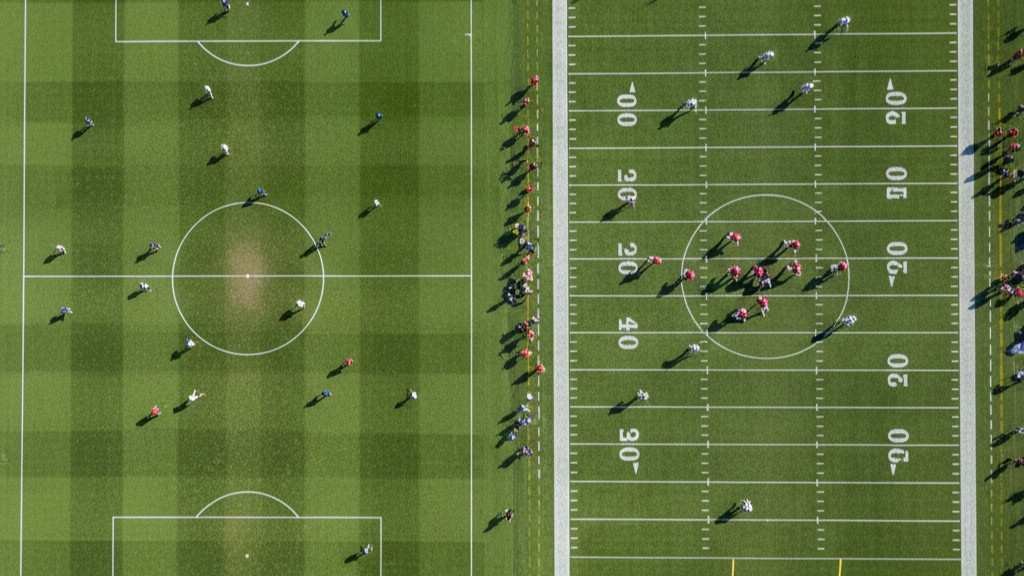
As someone who has spent their fair share of time on both a soccer field vs football field, I can confidently say that while they may look similar at first glance, they are worlds apart in terms of size, layout, and gameplay. I remember one afternoon, standing on a soccer field during my first match, trying to figure out how I was supposed to pass the ball across such a vast area.
Fast forward a few years, and I found myself in a completely different dilemma on a football field: understanding the yard lines and how they directly impact every move. The soccer field vs football field debate is more than just about dimensions—it’s about how these differences shape the sports themselves.
We will explore the key differences between a soccer field and a football field, including dimensions, markings, goals, and how the layout impacts each sport’s gameplay.
Key Differences: Soccer Field vs Football Field
While both fields may seem like they’re designed for similar purposes. Soccer vs football are fundamentally different in terms of size, layout, and markings. Here’s a side-by-side breakdown of how a soccer field compares to a football field:
|
Feature |
Soccer Field (FIFA Regulation) | American Football Field (NFL Regulation) |
|
Length |
110–120 yards (between goal lines for international matches) |
100 yards (between goal lines, 120 yards including end zones) |
|
Width |
70–80 yards (for international matches) |
53 1/3 yards |
|
Area |
7,700–9,600 square yards |
6,396 square yards (including end zones) |
| Standardization | Dimensions can vary within a set range |
Dimensions are strictly fixed |
|
Markings |
Penalty areas (18-yard box), goal areas, center circle, corner arcs |
Yard lines every 5 yards, hash marks, and end zones |
| Goals | 8 feet high by 24 feet wide rectangular net |
10 feet high crossbar with uprights 18.5 feet apart |
How Does the Difference in Size Affect Gameplay?
The dimensional differences between the two fields lead to vastly different styles of play. These differences aren’t just about how much space players have to move, but also how the games are structured and the kind of skills they emphasize.

1. Soccer’s Larger Field and Continuous Flow
The larger width of a soccer field allows for more lateral movement and gives players the space to perform strategic passing and cross-field runs. Because soccer is a continuous game, where the clock doesn’t stop often, players need to keep up their endurance and focus on fluid transitions from offense to defense.
The field’s expansive nature means that the strategy focuses heavily on teamwork, as passing and positioning across the width of the field are crucial to success.
2. Football’s Narrower, More Structured Field
In contrast, the narrower field of American football creates a much more concentrated environment, where every yard gained is critical. Football is a stop-and-start sport, with set plays and timeouts.
The yard lines and end zones create a structure where plays are executed in short bursts, and the goal is to advance specific amounts of yardage toward the end zone. The grid layout of the football field emphasizes vertical progression and allows coaches and players to plan out specific tactics for each phase of the game.
Markings on the Field: What’s the Deal with All Those Lines?
The field markings on a soccer field and a football field are designed to serve the rules and strategies of their respective sports. Let’s look at how the lines on each field differ.

1. Soccer Field Markings: Simple, Yet Significant
On a soccer field, the markings are relatively simple but extremely important. The penalty area (18-yard box) is where the goalkeeper can hold the ball, and the goal area is where goal kicks are taken. The center circle is where the game begins, and the corner arcs mark where corner kicks are taken. Each marking has a role in determining player positioning, game flow, and set-piece play.
2. Football Field Markings: A Grid of Precision
In comparison, a football field is a highly structured grid. It features yard lines every 5 yards, with markings at 1-yard intervals that give players precise markers for each play. The hash marks are used to indicate where plays begin after a stoppage.
The end zones are marked for scoring touchdowns, and goalposts are placed at each end for field goals and extra points. Football fields are designed to allow for precision in gameplay, with each yard gained or lost being a crucial part of the game.
How to Play on a Soccer Field vs a Football Field: Tips for Beginners
Now that you know the basic layout of each field, let’s talk about how these differences affect the gameplay in real life. Here are some practical tips if you’re a beginner looking to play or watch these sports.
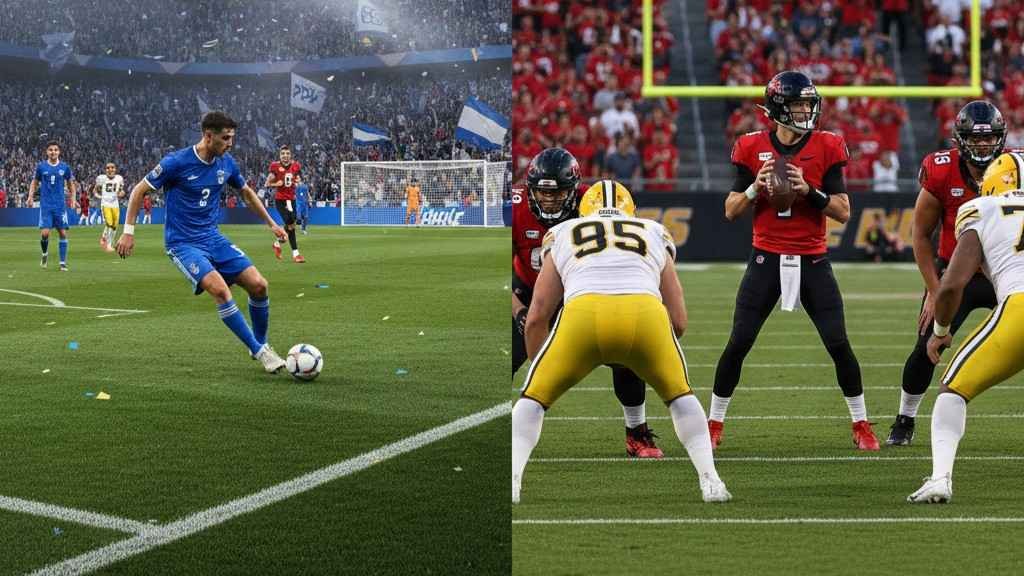
1. How to Play on a Soccer Field
Playing on a soccer field requires good endurance because the game is fast-paced and continuous. The field’s larger size means that passing is key to moving the ball around.
Strategic runs and off-the-ball movements help create space and open up opportunities for attacks. The key is to maintain possession and control the pace of the game while being able to quickly transition between offense and defense.
2. How to Play on a Football Field
On a football field, success depends on strategy and execution. The field’s precise dimensions make it easier to plan plays and structure them around gaining specific yards. Whether you’re on offense or defense.
You need to focus on your positioning and understand your role in the team as planned. Football is about concentration and timing, so knowing where the yard lines are and understanding how far you have to go for a first down or touchdown is crucial.
Frequently Asked Questions Answered
1. Can You Play Soccer on a Football Field?
Yes, you can! While a soccer field is generally wider and larger, soccer can be played on a football field in a pinch. The narrower football field limits the amount of lateral space for soccer players, but with some adjustments, like moving the goals or using cones for boundaries, you can still play soccer on a football field.
2. Why Are Soccer Fields Larger Than Football Fields?
Soccer fields are typically larger because soccer is a continuous game that emphasizes fluid movement, passing, and positioning. A larger field provides players with more space to move and create strategic plays. Football, in contrast, is more structured, with each play focusing on specific yardage and set positions.
3. Why Are Football Fields Narrower?
The narrower width of a football field is designed to accommodate the sport’s stop-and-start nature. The field is segmented into smaller yardage units, with each play focusing on a specific distance to be covered. This creates a more intense, focused environment where players concentrate on gaining or losing yards in defined sections.
So, Which Field Is Better for You?
At the end of the day, whether you’re debating on a soccer field vs football field, each field is perfectly suited to the game it’s made for. Soccer fields offer a wide-open space for strategic play, while football fields bring precision and structure to every yard gained. My personal advice?
Embrace both sports, and try your hand at playing on both types of fields. You’ll not only have a great time, but you’ll also gain a deeper understanding of how these fields shape the way their games are played. So grab a ball, head to the field, and enjoy the game!